
BODYBAR Pilates is a boutique Pilates franchise that takes the discipline of Pilates and reframes it as a high-intensity, low-impact group workout. As the franchise network grew, they needed two things at once: a way to bring new franchise owners online quickly and confidently, and a way to certify the instructors who would actually carry their method into every studio.
The challenge
A franchise model puts unusual pressure on training. The brand promise is consistency — a member walking into a BODYBAR in Dallas should get the same experience as one walking into a BODYBAR in Atlanta. But the people delivering that experience are independent operators and instructors hired locally, often new to franchising or to Pilates specifically.
The training couldn’t just be a manual. It needed to do three jobs simultaneously: equip new franchise owners with the operational backbone to run a studio, give instructors a real grounding in Pilates theory and movement science, and codify the BODYBAR method itself so it could be taught reliably across a growing network.
A franchise can’t scale on charisma. It scales on a system that travels.
What we built
The engagement started with the online portion of the new-franchisee training. The initial scope established the operational core: HR, Sales & Marketing, Accounting, and Operations modules, plus an introductory module, systems training on the franchise platform (CRUniversity), and the integrated quizzes that would verify comprehension before owners moved into live training.
With the franchisee operations live, BODYBAR’s Erica Naderi came back with the second half of the puzzle — an estimate for what would become the eight-module Instructor Program. This was the heart of the brand: how do you certify someone to teach Pilates the BODYBAR way?
The instructor curriculum
- Anatomy & Movement Science
- Teaching Skills
- Upper Body programming
- Lower Body programming
- Abdominal programming
- Auxiliary work
- Equipment fundamentals
- BODYBAR method & philosophy
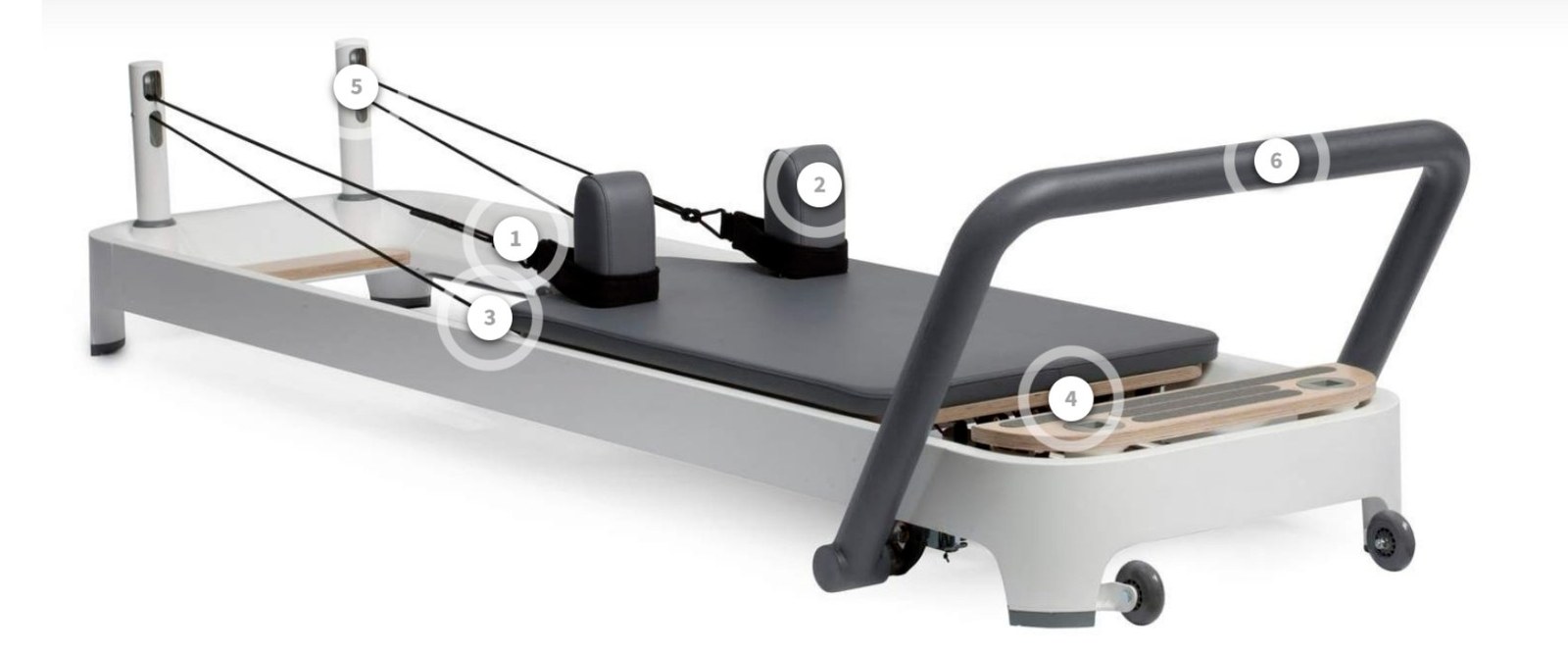
Each module was built in Articulate Rise 360, packaged as SCORM for the franchise LMS, and woven together with embedded video, downloadable resources, and assessments designed to verify recall — not just consumption. The equipment sections used interactive diagrams with numbered hotspots, letting trainees explore a reformer, a tower system, or an EXO chair the way they would in a real studio.

The hard part
Pilates is an instructed discipline. The classical method is taught in person, hands-on, over hundreds of practice hours. Translating that into a digital format without losing the essence is a genuine instructional design problem — one most fitness eLearning gets wrong by either over-simplifying it into trivia or over-loading it with information that learners can’t apply.
The approach was to treat the digital modules as the pre-floor layer. The job wasn’t to replace the hands-on training; it was to make sure that when a trainee stepped onto the floor for in-person evaluation, they already understood the philosophy, the anatomy, the equipment, and the structure of a class. The digital portion earned them the right to practice.
Pre-floor training isn’t a substitute for hands-on instruction. It’s the load-bearing structure that lets hands-on instruction focus on what only hands-on can do.
The ongoing engagement
What started as a defined-scope build became a partnership. The modules came back for revisions over multiple cycles — minor edits across HR, Financial Management, Marketing, and Operations; a near-total rewrite of the Sales module as the franchise refined its go-to-market; and later, work to update the LMS with new exercise videos, build sections specifically for Bridge participants (a flex pathway for already-credentialed instructors), and recalibrate completion requirements to match how the network had actually evolved.
This is the part of L&D work that doesn’t make it into proposals. A training program isn’t a deliverable — it’s a living system that needs maintenance as the business it supports keeps moving. Being able to come back, refresh, and keep the curriculum in sync with the brand has been as important as the initial build.
The outcome
Feedback from the BODYBAR leadership team has been consistent across stakeholders. Kamille McCollum and Erica Naderi both highlighted the strength of the instructional design — calling out the clarity of the learning flow, the quality of the embedded assessments, and the curriculum’s readiness for deployment across new studios. The franchise has continued to invest in the curriculum across multiple years and program expansions, which is the metric that matters most: clients who come back.
The instructional design across these modules is excellent. The flow is clean and well-paced, the assessments effectively reinforce the material, and the overall experience meets the brand standards we hold ourselves to. It’s become foundational to how we onboard and certify our instructor team.
— BODYBAR Pilates leadership team
More than the feedback, the work itself has become the operational backbone the brand needed. New franchise owners come through the same curriculum. New instructors learn the BODYBAR method through the same anatomy, the same teaching framework, the same equipment fundamentals. The brand consistency that franchising depends on isn’t enforced by policy — it’s carried by the curriculum itself, every time a new person joins the network.